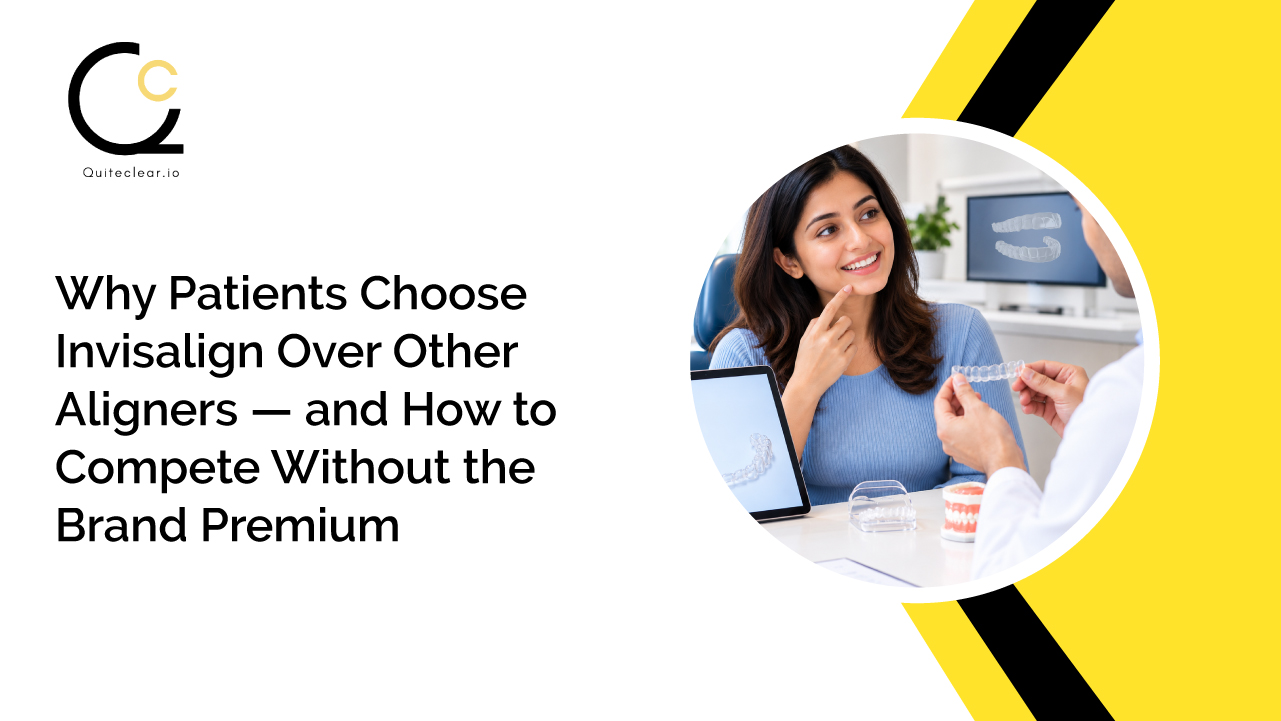
Why Patients Choose Invisalign Over Other Aligners — and How to Compete Without the Brand Premium
Imagine a patient walking into a dental clinic and saying, “I want Invisalign.”
They haven’t compared every clear aligner brand or explored all their treatment options. They already have a name in mind.
For dental clinics and alternative aligner manufacturers, this presents a challenge. Invisalign has strong brand recognition, while lesser-known clear aligner brands often have to work harder to earn patient trust.
But does a familiar brand name always determine the best treatment choice?
Not necessarily. Patients also consider clinical suitability, the dentist’s recommendation, treatment experience, and overall cost.
For businesses offering Invisalign alternatives, the opportunity lies in understanding what patients value and demonstrating why their solutions deserve consideration. Here’s how clear aligner brands can compete without relying on the brand premium alone.
Why Do Patients Choose Invisalign Over Generic Aligners?
Patients don’t always compare products based on technical specifications. Familiarity, perceived reliability, and professional recommendations can influence their decisions just as much.
Let’s explore the key factors that give established clear aligner brands a competitive advantage.
- Brand Recognition Builds Instant Trust: Think about the last time you purchased something from a familiar brand. You probably felt more comfortable considering it because you already knew its name.
The same principle applies to clear aligner treatment.
Through advertising, social media, patient testimonials, and word of mouth, Invisalign has become a recognisable name in orthodontic treatment. Patients researching clear aligners may already associate the brand with teeth straightening and a modern treatment experience.
Generic aligners and lesser-known alternatives face a different challenge. Even when a product offers relevant features, patients may hesitate because they have limited information about the brand.
How to compete: Build brand awareness through patient education, genuine testimonials, clear product information, and consistent communication. Help potential customers understand what your aligner system offers instead of expecting them to trust an unfamiliar name immediately.
- Patients Want Confidence in Treatment Outcomes: Straightening teeth is a personal investment. Patients want to understand whether a treatment is appropriate for their dental condition and what the process will involve.
A familiar brand may provide reassurance, but clinical suitability depends on several factors, including case complexity, treatment planning, and the expertise of the treating professional.
Alternative clear aligner providers can strengthen their position by demonstrating their capabilities, offering appropriate clinical resources, and helping dental professionals make informed treatment decisions.
The goal isn’t to claim that every clear aligner system produces identical results. It’s to demonstrate where a particular solution is suitable and support its claims with credible evidence.
- Dentist Recommendations Influence Patient Choices: Patients may enter a clinic with a preferred aligner brand, but their dentist or orthodontist can influence the final decision.
When clinicians understand a product’s capabilities, treatment-planning process, and limitations, they can explain its suitability more confidently.
For aligner manufacturers, this means providing more than an attractive price. Training, accessible technical support, clear documentation, dependable communication, and sample kits displaying aligner quality can help dental professionals evaluate an alternative aligner system.
Building trust with clinicians can also help manufacturers develop lasting partnerships rather than relying exclusively on direct-to-consumer marketing.
- Technology Shapes the Treatment Experience: Digital scanning, customised treatment planning, and visual simulations have changed how patients experience orthodontic treatment.
Patients want to understand their treatment journey, how progress will be monitored, and what they can reasonably expect.
Alternative aligner brands should communicate the actual capabilities of their digital workflows and treatment-planning tools. Demonstrations and educational materials can help dentists and patients understand their practical benefits.
Technology is valuable when it supports the treatment process, not simply when it sounds impressive in marketing materials.
- Patients Consider Value Beyond Price: A lower price can attract attention, but it doesn’t automatically convince someone to choose a lesser-known brand.
Patients may also consider clinician expertise, follow-up appointments, treatment monitoring, refinements, convenience, and confidence in the overall process.
This is why competing exclusively on affordability can be limiting. If an alternative aligner brand communicates only that it costs less, patients may wonder whether they’re sacrificing quality or support.
A stronger approach is to explain the complete treatment value and make package inclusions clear.
Understanding the Invisalign Brand Premium
Why might patients pay more for a recognised clear aligner brand? The answer can extend beyond the physical product itself. A brand premium may reflect a combination of perceived value, brand recognition, technology, professional resources, and marketing.
- Brand equity: Familiarity and reputation can make a recognised brand feel like a more reassuring choice.
- Technology and infrastructure: Digital treatment-planning platforms and supporting resources contribute to the overall offering.
- Professional support: Training, provider networks, and clinical resources can influence a dentist’s confidence.
- Marketing investment: Advertising and patient education help established brands remain visible throughout the purchasing journey.
- Perceived risk reduction: Patients may feel more comfortable choosing a name they already recognise.
For alternative aligner manufacturers, the lesson is not to replicate every part of an established brand’s business model. It is to identify which benefits matter most to their customers and demonstrate how their solutions deliver value.
How Generic Aligner Brands Can Compete Without the Brand Premium
Competing with an established clear aligner brand doesn’t mean copying its marketing strategy or offering the lowest price. It means giving dentists and patients compelling reasons to consider an alternative.
- Focus on Clinical Value, Not Just Lower Prices: Price is easy to compare. Clinical value requires a clearer explanation. Instead of leading every conversation with affordability, highlight the aligner system’s capabilities, treatment suitability, quality standards, and professional support. Use credible evidence to support product claims and communicate limitations honestly. A clear explanation of what a system can and cannot do builds more confidence than unrealistic promises.
- Make Technology Easy to Understand: Technical features mean little if dentists and patients cannot see how they improve the treatment experience. Explain how digital workflows, treatment-planning tools, and progress monitoring work where these features are available. Use demonstrations and educational content to show their practical benefits. The objective is to make the technology understandable and relevant, not simply to make the product sound advanced.
- Build Strong Relationships With Dental Professionals: A dentist who understands a product and trusts the support behind it is better equipped to assess whether it suits a patient’s needs. Clear aligner manufacturers can strengthen these relationships through product training, accessible technical assistance, transparent documentation, and responsive communication. For dental practices, dependable support can simplify workflows. For manufacturers, it creates an opportunity to build long-term partnerships rather than compete for one-time orders.
- Improve the Entire Patient Experience: Patients remember more than the aligners themselves. They remember how clearly their treatment was explained, whether their questions were answered, and how supported they felt throughout the process. Work with dental partners to make consultations, treatment expectations, follow-ups, and aftercare as straightforward as possible. A positive patient experience can help strengthen trust, even when the brand isn’t widely recognised.
- Offer Transparent and Competitive Pricing: A low starting price doesn’t necessarily represent better value if important services are excluded. Explain what the treatment package covers, including relevant consultations, refinements, retainers, and follow-up care. Inclusions will vary by provider, so ensure all pricing information is accurate. Transparent pricing helps patients compare Invisalign alternatives more meaningfully and allows clinics to discuss affordability without making it the sole selling point.
- Use Proof to Build Brand Credibility: When a brand lacks widespread recognition, credible proof becomes especially important. Share verified clinical case studies, genuine patient testimonials, clinician feedback, and documented quality standards where available. Obtain appropriate consent for patient stories and ensure all claims are accurate. Over time, consistent evidence and dependable service can help an alternative aligner brand establish its own reputation.
Common Mistakes to Avoid When Competing With Established Aligner Brands
Even a well-designed product can struggle if its positioning is weak. Avoid these common mistakes:
- Competing only on price: This can make your product appear interchangeable with every other low-cost option.
- Making unsupported claims: Avoid suggesting that all clear aligners deliver identical results or that one system is universally superior.
- Ignoring clinician support: A competitive product still needs appropriate training, information, and assistance.
- Overpromising treatment outcomes: Results and timelines depend on individual clinical circumstances and patient compliance.
- Prioritising visibility over credibility: Marketing may generate interest, but trust must be earned through product quality and the treatment experience.
The strongest alternative isn’t necessarily the cheapest one. It’s the one that can demonstrate why it deserves consideration.
Invisalign’s brand recognition gives it an advantage, but alternative clear aligner brands can still compete by demonstrating genuine value. Clinical suitability, transparent pricing, reliable professional support, appropriate technology, and a positive patient experience can all contribute to a compelling value proposition.
Instead of asking, How can we make patients choose us over Invisalign?, ask a more useful question: What can we offer that genuinely meets our customers’ needs, and how can we prove it?
A strong clear aligner brand isn’t built by being the cheapest alternative. It’s built by giving dentists and patients credible reasons to choose it.
Choosing the right aligner manufacturing partner involves more than comparing prices. Product quality, consistent supply, communication, and the ability to support your business as it grows all deserve consideration. Quiteclear can help you explore clear aligner solutions for your dental business. Connect with Quiteclear to discuss your requirements and identify an approach that aligns with your practice’s needs and growth plans.