Inside an Aligner Manufacturing Company: Process, Technology, and Quality Standards
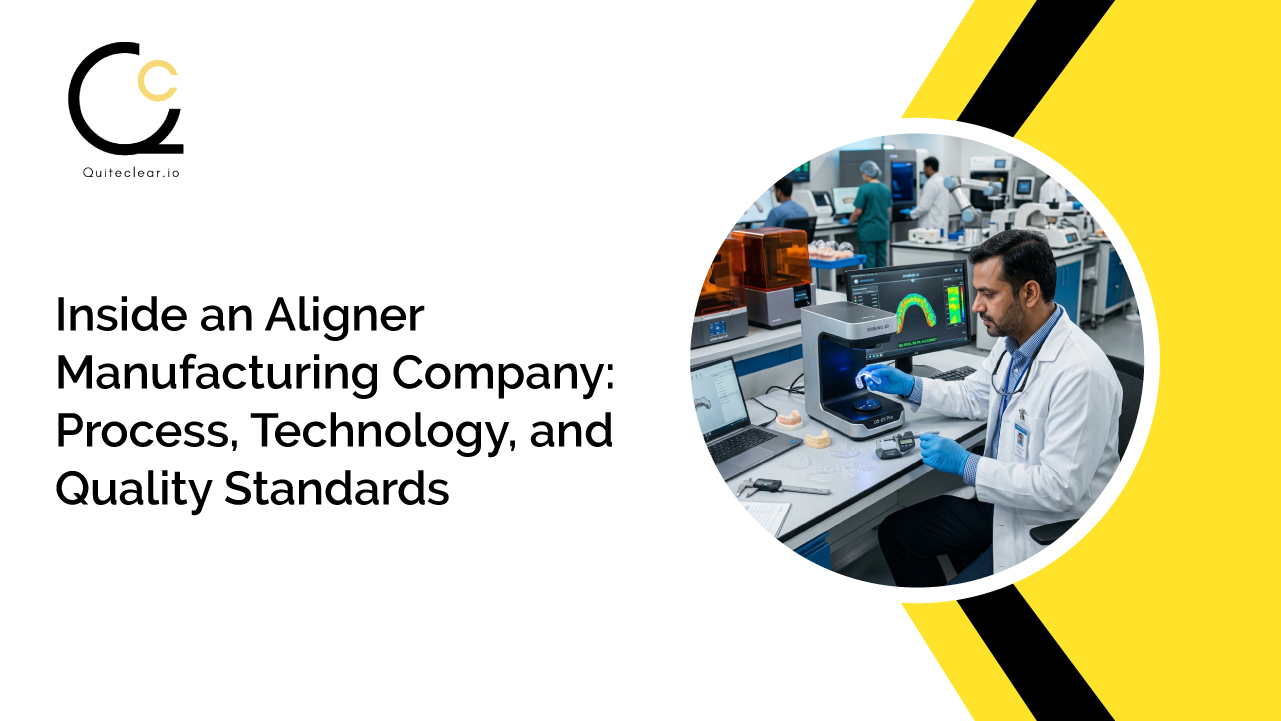
Most aligners look the same when they arrive at your clinic: clear, neatly packed, and ready to use. But what if the real difference isn’t visible at all?
Behind every aligner is a complex chain of decisions on how the treatment was planned, how precisely the model was printed, how consistent the material is, and how rigorously quality checks were done. And those decisions don’t just stay in the lab; they show up chairside. In the form of a better fit, fewer refinements, smoother tracking, and ultimately, more predictable outcomes.
Yet, many clinics still choose providers based on cost or turnaround time, without fully understanding what happens behind the scenes.
At QuitecClear, we believe the manufacturing process isn’t just a backend operation; it’s the foundation of clinical success. In this blog, we take you inside a modern aligner manufacturing company, unpacking the process, technology, and quality standards that truly make a difference.
The End-to-End Aligner Manufacturing Workflow
The aligner manufacturing process begins long before production;, it starts with data. Clinics gathersubmit intraoral scans or impressions, and the accuracy of this initial input sets the foundation for everything that follows. Even minor errors at this stage can lead to a poor fit and additional refinements later.
Once the case is received, it moves into Ddigital treatment planning is the first step. Here, advanced software maps out each stage of tooth movement, often combining AI-driven simulations with expert oversight. The goal is not just to move teeth, but to do so predictably and efficiently, while giving clinicians the flexibility to review and refine the plan. We believe this step is best done by a well-experienced Orthodontist.
After approval, the case transitions into production, where digital designs are translated into physical aligners. This seamless workflow, from scan to setup to manufacturing, ensures consistency at every step.
At QuitecClear, emphasis is placed on precision early in the process because better inputs and smarter planning lead to better outcomes. We encourage Orthodontists to send us planned treatment files for manufacturing. If there are clinicians who are still not confident to plan themselves. We connect them to experienced Orthodontists who can assist in the planning for a fee.
3D Modeling & Simulation Technology
Once the initial case data is validated, the process moves into one of the most critical stages: 3D modeling and simulation. This is where raw scan data is transformed into a precise digital replica of the patient’s dentition. Advanced software then maps out the entire treatment journey, breaking it into incremental tooth movements across each aligner stage.
Modern aligner systems rely heavily on AI-assisted simulations to predict how teeth will move over time. These systems consider factors like force application, tooth anatomy, and movement limitations to create a realistic treatment plan. However, technology alone isn’t enough. The best outcomes come from a balance between automation and expert review, where clinicians can assess, modify, and approve the setup before manufacturing begins.
The accuracy of these simulations plays a direct role in treatment predictability. Poor planning often leads to tracking issues and refinements, increasing chair time and patient frustration. High-quality simulation, on the other hand, ensures smoother progression and better alignment with expected outcomes.
At QuiteClear, the focus is on delivering highly accurate digital setups that minimize guesswork and maximize clinical confidence from the very beginning.
Manufacturing Process (Step-by-Step)
After receiving the digital filestreatment approval, the process transitions from digital to physical production. The first step involves 3D printing a series of dental models, each representing a stage of tooth movement. The precision of these models is critical; any deviation, even at a micron level, can impact the fit of the final aligner.
Once the models are printed, thermoforming takes place. In this step, medical-grade plastic sheets are heated and molded over the printed models to create the aligners. Uniform pressure and temperature control are essential to ensure that each aligner maintains the intended shape and delivers consistent force.
Following thermoforming, aligners undergo trimming, polishing, and finishing. Excess material is removed, edges are smoothed, and each piece is refined for patient comfort. This stage may seem minor, but poorly finished aligners can cause discomfort, affecting patient compliance.
The final step includes cleaning, labeling, and packaging each aligner set in sequence. A well-controlled manufacturing process ensures that every aligner fits accurately and performs as intended throughout the treatment cycle.
Materials & Their Impact on Treatment
The material used in aligner production is not just about aesthetics; it directly affects performance. High-quality aligners are made from medical-grade, BPA-free thermoplastics designed for clarity, durability, and biocompatibility.
Material properties such as flexibility and strength determine how effectively forces are applied to teeth. If the material is too rigid, it can cause discomfort and excessive pressure. If it’s too soft, it may not deliver sufficient force, leading to ineffective movement. Achieving the right balance is key to consistent and predictable results.
Durability is another critical factor. Aligners are typically worn for 20–22 hours a day, so they must maintain their shape and effectiveness over time. Inferior materials may warp, discolor, or degrade, compromising both function and patient experience.
At QuitecClear, material selection is guided by clinical performance. The goal is to ensure that each aligner maintains its integrity throughout its wear cycle, delivering consistent force and comfort without compromise.
Quality Control & Assurance Standards
Quality control is where a good manufacturing process becomes a reliable one. Every aligner must meet strict standards before it reaches the clinic. This begins with fit accuracy checks, where aligners are verified against digital models to ensure precision within acceptable tolerance levels.
Consistency across batches is equally important. Since treatment involves multiple aligners worn sequentially, each one must align perfectly with the planned progression. Even slight inconsistencies can disrupt tracking and lead to refinements.
In addition to internal checks, manufacturers must adhere to global safety and compliance standards. This includes using certified materials, maintaining sterile production environments, and following regulated manufacturing protocols.
Effective quality assurance systems are proactive, not reactive. Instead of catching defects after production, they are designed to prevent errors at every stage, from data intake to final packaging.
For clinics, strong quality control translates into fewer surprises, smoother treatments, and higher patient satisfaction. It’s one of the clearest differentiators between standard and premium aligner providers.
Turnaround Time & Operational Efficiency
Turnaround time is often a key consideration for clinics, but speed should never come at the cost of quality. The typical timeline includes case submission, treatment planning, approval, manufacturing, and delivery. Each stage must be efficiently managed to ensure timely yet accurate outcomes.
Reliable turnaround times help clinics maintain predictable schedules and improve patient experience. Delays can lead to missed appointments, extended treatment durations, and dissatisfaction. However, overly rushed processes can compromise precision, leading to issues that ultimately take longer to correct.
The real value lies in consistency. Clinics need to trust that timelines will be met without unexpected delays or quality issues. This requires a well-coordinated system where technology, manufacturing, and logistics work seamlessly together.
At QuitecClear, the focus is on delivering dependable timelines without cutting corners. Because in aligner treatment, efficiency isn’t just about speed, it’s about delivering the right product, at the right time, with the right level of precision.
Common Manufacturing Challenges (and Their Impact)
Even with advanced technology, aligner manufacturing isn’t without challenges, and how these are managed directly affects treatment outcomes. One of the most common issues is poor fit, often caused by inaccuracies in scanning, modeling, or production. This can lead to tracking problems, requiring refinements that increase treatment time and chairside effort.
Material inconsistency is another critical challenge. Variations in thickness or flexibility can impact force delivery, causing discomfort or ineffective tooth movement. Over time, this affects both patient compliance and clinical predictability.
Delays in production or delivery also disrupt clinic workflows. Missed timelines can result in rescheduling, longer treatment cycles, and reduced patient satisfaction.
The key difference lies in how manufacturers handle these challenges. Proactive quality control, consistent materials, and reliable processes can significantly minimize these risks, ensuring smoother treatments and better outcomes for both clinics and patients.
Behind every successful aligner treatment is a process most patients and even many clinics never see. From precise digital planning to material selection and rigorous quality control, each step plays a direct role in how well a case progresses. When any part of this chain is compromised, the impact shows up quickly in the form of poor fit, increased refinements, longer treatment times, and frustrated patients.
The takeaway is simple: aligner manufacturing isn’t just a backend function; it’s the foundation of predictable outcomes. Choosing the right partner isn’t about who is fastest or cheapest, but who is most consistent, precise, and clinically reliable.
At QuitecClear, we focus on getting the fundamentals right because that’s what drives better results chairside. If you’re looking to reduce refinements, improve case predictability, and deliver a better patient experience, it’s time to evaluate what’s happening behind your aligners.
Connect with Book a demo with QuitecClear and experience the difference precision-driven manufacturing can make.