
Orthodontic Buttons for Elastics: Clinical Applications, Benefits & Best Practices
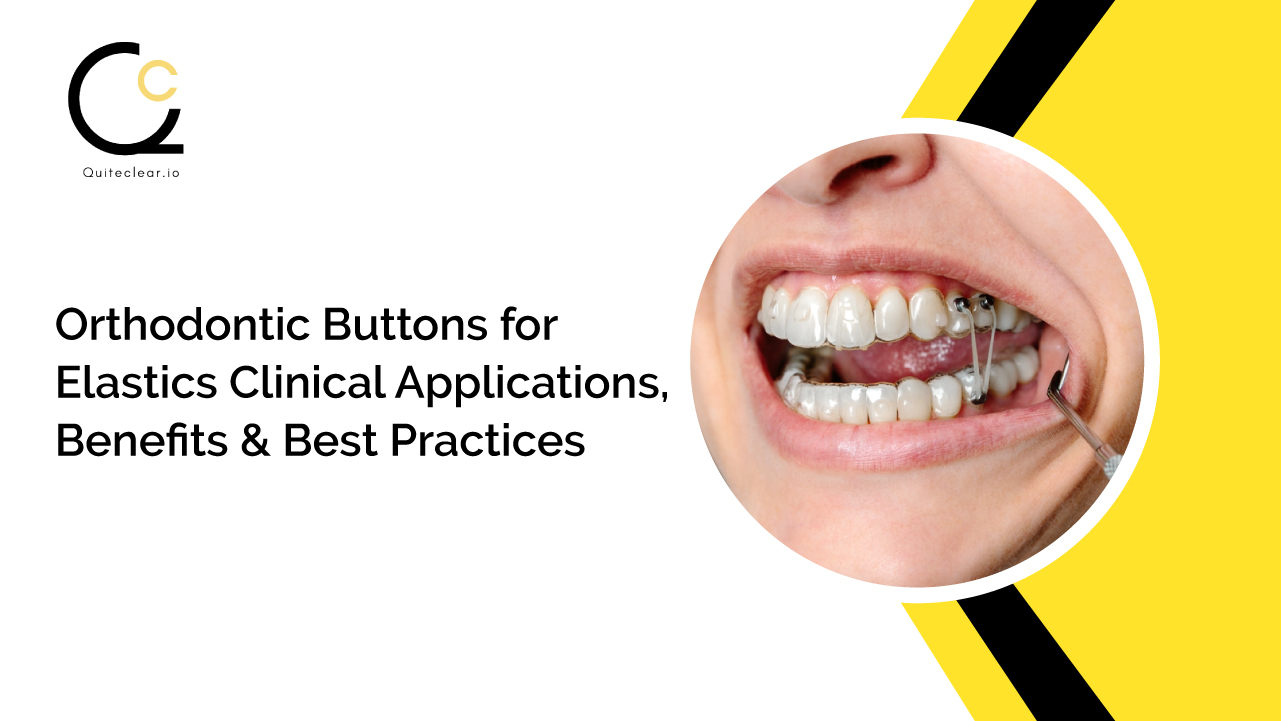
Elastics play a crucial role in orthodontic treatment, helping guide tooth movement, correct bite discrepancies, and achieve functional alignment. While much attention is given to brackets, wires, and aligners, orthodontic buttons often work quietly in the background; yet they are essential for precise and controlled elastic mechanics.
Orthodontic buttons provide reliable attachment points when traditional brackets or hooks are impractical or ineffective. Whether used for interarch elastics, impacted tooth traction, or hybrid aligner treatments, these small components allow clinicians to apply targeted forces with greater flexibility and accuracy.
As orthodontic treatment plans become more customized and biomechanics-driven, the strategic use of buttons has become increasingly important. From complex malocclusions to clear aligner cases that require supplemental anchorage, orthodontic buttons help bridge the gap between treatment design and real-world clinical execution.
What Are Orthodontic Buttons?
Orthodontic buttons are small, low-profile appliances bonded directly to the tooth surface to serve as attachment points for elastics or auxiliary forces during orthodontic treatment. Their primary purpose is to provide a secure and precise anchor when traditional brackets or hooks are not suitable or available. Because of their compact design, orthodontic buttons allow clinicians to apply controlled forces without significantly interfering with occlusion or patient comfort.
Why Orthodontic Buttons Are Used With Elastics?
Elastics are essential in orthodontic treatment for applying controlled forces that correct bite relationships, guide tooth movement, and support anchorage. To function effectively, elastics require stable and well-positioned attachment points.
Orthodontic buttons are often preferred because they can be bonded exactly where the desired force direction is needed, without being restricted by bracket or archwire placement. Their low-profile design minimizes occlusal interference and improves patient comfort.
In cases such as impacted teeth, lingual surfaces, posterior regions, or clear aligner treatments, brackets or hooks may be impractical or ineffective. Orthodontic buttons provide a reliable alternative, allowing precise elastic wear while maintaining treatment efficiency and flexibility.
Clinical Applications of Orthodontic Buttons for Elastics
Orthodontic buttons are widely used across a range of treatment scenarios where precise elastic mechanics are required. Their flexibility in placement allows clinicians to apply targeted forces that are difficult to achieve with brackets or hooks alone.
- Class II & Class III correction: Buttons provide stable attachment points for interarch elastics used to correct sagittal discrepancies. Their precise positioning helps optimize force vectors, improving efficiency in Class II and Class III bite correction.
- Crossbite and midline correction: In transverse and asymmetry cases, buttons enable selective elastic pull to guide individual teeth or segments. This is especially useful for correcting dental crossbites and midline deviations without overloading adjacent teeth.
- Space closure and anchorage control: Buttons support controlled space closure by directing elastic forces where additional anchorage or reinforcement is needed, particularly in complex extraction or finishing phases.
- Impacted teeth traction: For impacted or partially erupted teeth, buttons are often the preferred choice, allowing elastic traction when brackets cannot be bonded safely or effectively.
- Aligner-assisted orthodontics: In clear aligner treatments, orthodontic buttons work alongside aligners to facilitate elastic wear, helping manage bite correction and movements beyond aligner-only capabilities.
Types of Orthodontic Buttons Used for Elastics
Orthodontic buttons are available in different designs and configurations to support a wide range of elastic mechanics. Selecting the right type depends on treatment goals, force requirements, tooth position, and patient comfort.
- Bondable buttons vs welded buttons: Bondable buttons are directly bonded to the tooth surface using orthodontic adhesive, offering flexibility in placement and ease of repositioning. They are commonly used for elastics, traction, and aligner-assisted treatments. Welded buttons, typically attached to bands or auxiliary appliances, provide added strength and stability and are preferred in cases requiring higher or prolonged force application.
- Lingual vs buccal buttons: Buccal buttons are placed on the cheek-facing surfaces of teeth and are most commonly used for interarch elastics and bite correction. Lingual buttons are bonded on the tongue-facing surfaces and are useful when aesthetics are a concern or when buccal placement interferes with occlusion or appliance design.
- Low-profile vs standard buttons: Low-profile buttons are designed to minimize bulk, reducing soft tissue irritation and improving patient comfort. They are ideal for areas with limited space or opposing occlusion. Standard buttons offer a slightly larger surface area, providing improved elastic retention in cases where stronger or continuous force is required.
- Material-based comparison (metal vs ceramic): Metal buttons are the most widely used due to their durability, strong bonding, and resistance to wear. Ceramic buttons offer better aesthetics and blend with tooth color, making them suitable for visible areas, though they may have slightly higher debonding risk compared to metal options.
Choosing the appropriate button type ensures effective elastic performance while balancing comfort, aesthetics, and clinical reliability.
Orthodontic Buttons in Modern & Aligner-Based Treatments
In modern orthodontics, orthodontic buttons play an important supportive role alongside clear aligners. While aligners can achieve many planned movements, buttons provide reliable attachment points for elastics to manage bite correction, anchorage, and complex force systems that aligners alone may not fully address.
Hybrid treatment approaches combine clear aligners with strategically placed orthodontic buttons to enhance treatment efficiency without shifting to full fixed appliances. This allows clinicians to maintain aesthetics while gaining greater biomechanical control.
Even in “bracket-free” orthodontics, buttons are often essential for Class II or Class III correction, vertical control, or impacted tooth traction; ensuring predictable outcomes while preserving the benefits of aligner-based treatment.
Clinical Tips for Optimizing Outcomes
Successful use of orthodontic buttons with elastics depends on thoughtful case planning and ongoing clinical evaluation. Proper case selection is key; buttons are most effective in treatments requiring precise force direction, supplemental anchorage, or elastic wear that cannot be achieved predictably with brackets or aligners alone.
Repositioning or replacing buttons may be necessary if force vectors change during treatment, if a button interferes with occlusion, or in cases of repeated debonding. Timely adjustment helps maintain biomechanical efficiency and prevents unwanted tooth movement.
Careful coordination of elastic strength and wear schedules is equally important. Selecting the appropriate elastic size and force level, combined with clear patient instructions, ensures consistent force application without overloading teeth or supporting structures.
Finally, continuous monitoring of biomechanics, including tooth response, anchorage effects, and patient compliance, allows clinicians to make proactive adjustments, ensuring controlled movement and predictable treatment outcomes.
Predictable orthodontic outcomes come from combining smart digital planning with proven clinical tools. Orthodontic buttons, when used thoughtfully, support this balance, helping clinicians deliver efficient, comfortable, and reliable treatments.
Looking to optimize your aligner-based treatments with better biomechanical support?
Connect with our team to see how hybrid approaches can elevate your clinical outcomes. Quiteclear’s manufacturing includes button cutouts that are precise to digital cut-out marks placed on digital files with-in the treatment planning software.
FAQs-
- What are orthodontic buttons used for in elastic-based treatments?
Orthodontic buttons act as secure attachment points for elastics, helping apply controlled forces for bite correction, space closure, impacted tooth traction, and anchorage support, especially when brackets or hooks are not ideal.
- Are orthodontic buttons necessary in clear aligner treatment?
Yes, in certain cases. While clear aligners handle many tooth movements, orthodontic buttons are often required for interarch elastics, Class II or Class III correction, and complex biomechanical control that aligners alone cannot predictably achieve.
- Do orthodontic buttons cause discomfort for patients?
Orthodontic buttons are designed to be low-profile and minimally intrusive. When placed correctly, they are generally well tolerated, with any initial discomfort typically resolving as the patient adapts.
- How long do orthodontic buttons stay on the teeth?
Buttons remain in place only as long as they are needed for elastic wear or traction. Once their role is complete, they can be easily removed without affecting the overall treatment plan. - Want to know how orthodontic buttons integrate with Quiteclear’s whitelabel clear aligners?
If you’re exploring hybrid or aligner-assisted orthodontic treatments, Quiteclear can help you execute the use of orthodontic buttons effectively.