The Real Economics of MOQs in Clear Aligner Manufacturing (What Practices Often Miscalculate)
A clear aligner manufacturer quotes you a lower price at 5,000 units instead of 1,000.
Sounds like a better deal, right?
Not necessarily.
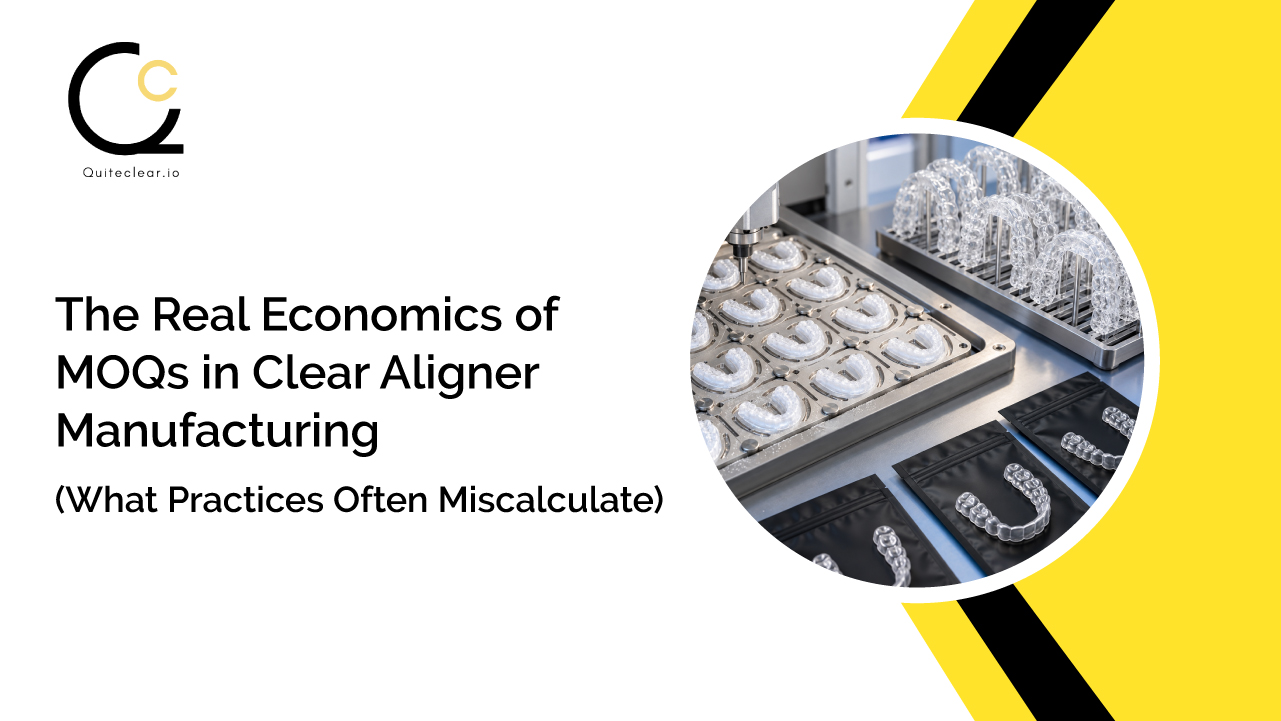
Minimum Order Quantity (MOQ) can look like a simple purchasing number, but it directly affects your cash flow, inventory, storage, wastage, and overall cost per usable aligner.
Many practices focus on price per aligner and overlook what that MOQ actually costs them.
In this guide, we’ll break down the real economics of MOQs in clear aligner manufacturing and what practices should calculate before placing their next order.
What Does MOQ Mean in Clear Aligner Manufacturing?
MOQ (Minimum Order Quantity) is the smallest quantity of clear aligners a manufacturer requires a practice, clinic, or brand to order in a single production run or purchase.
For example, if a manufacturer sets an MOQ of 500 aligners, you may need to order at least 500 units to access that production price or manufacturing arrangement. In clear aligner manufacturing, MOQs can vary based on factors such as:
- Production volume: Larger orders may offer lower per-unit costs.
- Customization: Branded packaging, labeling, or specific product requirements can affect minimum quantities.
- Materials and production setup: Manufacturers may need to purchase or prepare materials in specific quantities.
- Packaging: Custom boxes, bags, and other components may also have their own minimum quantities.
- Manufacturing capacity: MOQs help manufacturers plan production efficiently.
However, MOQ isn’t simply about how many aligners you have to buy. It determines how much cash you commit upfront, how much inventory you hold, and how much flexibility you have to respond to actual patient demand.
That’s why the right question isn’t just “What is your MOQ?”
It’s “Does this MOQ make financial sense for our actual case volume?”
Why Clear Aligner Manufacturers Use MOQs?
MOQs aren’t just a way for manufacturers to push larger orders. They help make the production process economically and operationally viable. Clear aligners involve multiple steps, from material preparation and digital production to thermoforming, trimming, quality checks, packaging, and shipping. Running very small batches can make these fixed costs difficult to absorb.
Manufacturers typically use MOQs to:
- Spread production costs: Equipment setup, labor, quality checks, and other fixed costs are easier to manage across larger batches.
- Purchase materials efficiently: Materials and packaging are often sourced in bulk, making larger production runs more practical.
- Reduce production inefficiencies: Larger batches allow manufacturers to use equipment and production capacity more efficiently.
- Manage custom requirements: Custom branding, packaging, and labeling may require minimum quantities to be commercially viable.
- Plan production capacity: Predictable order volumes help manufacturers allocate machines, labor, and production schedules.
- Keep pricing competitive: Higher volumes can reduce the manufacturing cost per aligner, allowing suppliers to offer better unit pricing.
MOQ exists to balance the manufacturer’s production economics. But for a practice, the same MOQ needs to be evaluated against actual demand, cash flow, inventory risk, and expected utilization.
The Hidden Costs Practices Often Miscalculate
The price quoted by a clear aligner manufacturer is only one part of the cost. A large MOQ can look attractive because of a lower per-unit price, but the real expense often appears after the order is placed. Practices should consider:
- Cash tied up in inventory: A larger order means more money committed upfront, even if those aligners take months to get used.
- Unused inventory: If case volumes are lower than expected, some of the purchased stock may sit unused.
- Storage and handling: Larger quantities require more space and add handling and inventory-management costs.
- Shipping costs: Bulk orders may reduce shipping per unit, but frequent smaller orders can increase logistics expenses.
- Wastage: Damaged, incorrect, or unused aligners add to the effective cost of each usable unit.
- Reordering costs: Very low MOQs may mean more frequent orders, increasing shipping, administration, and procurement effort.
- Working capital impact: Money locked into inventory cannot be used for marketing, equipment, staffing, or other business needs.
- Demand uncertainty: If patient volume changes, a high MOQ can leave practices holding more inventory than they actually need.
The real calculation
Instead of looking only at cost per aligner, practices should calculate their effective cost per usable aligner:
Total purchase + logistics + storage + wastage + inventory costs ÷ Aligners actually used
That number gives a much clearer picture of whether an MOQ is genuinely economical or simply looks cheaper on paper.
When a Higher MOQ Actually Makes Financial Sense?
A higher MOQ isn’t always a bad thing. It can work well when a practice has predictable demand and consistent case volume. A higher MOQ may make financial sense when:
- Case volumes are high and predictable
- The lower unit price creates meaningful savings
- Storage capacity is available
- The practice has enough working capital
- Bulk ordering reduces shipping and handling costs
- The manufacturer offers reliable production and quality
The key is utilization. If the practice can consistently use the inventory, the lower per-unit cost can outweigh the higher upfront investment.
When a Lower MOQ Is the Smarter Choice?
For newer or growing practices, flexibility can be more valuable than a lower unit price. A lower MOQ may be the better choice when:
- Patient volumes are still unpredictable
- The practice is testing a new aligner program
- Launching a new branded clear aligner
- Entering a new market
- Cash flow is a priority
- Product demand may change quickly
A lower MOQ reduces the amount of capital tied up in inventory and lets practices scale their orders as actual demand grows.
The best MOQ isn’t the lowest or highest; it’s the one that matches your current business volume and growth stage.
Questions to Ask Your Clear Aligner Manufacturer Before Agreeing to an MOQ
- Is the MOQ per order or per product?
- Can MOQ be negotiated based on annual volume?
- Are volume discounts available?
- What happens if demand falls below the MOQ?
- What are the production lead times?
- Can orders be split into multiple shipments?
- What are the storage requirements?
- What happens to defective units?
- What are the rework/replacement policies?
- Are shipping costs included?
- Can production be forecasted monthly?
- Are there setup or tooling fees?
- Can packaging and branding be customized?
- What happens when the product specification changes?
How to Negotiate Better MOQ Terms?
Negotiating an MOQ doesn’t always mean asking the manufacturer to simply lower the quantity. A better approach is to negotiate a structure that gives you cost efficiency without unnecessary inventory risk. Practices can explore:
- Staggered deliveries: Commit to a larger volume but receive it in smaller batches.
- Volume-based pricing: Negotiate better unit pricing based on expected annual orders.
- Quarterly commitments: Agree on a predictable purchasing schedule instead of one large upfront order.
- Pilot batches: Start with a smaller quantity before committing to larger production volumes.
- Flexible packaging: Negotiate lower minimums for customized packaging and branding.
- Forecast-based production: Share expected case volumes so the manufacturer can plan production around your demand.
The goal is simple: build an MOQ agreement that works for both the manufacturer’s production economics and your practice’s actual demand.
MOQ is more than a number on a manufacturer’s quotation. It directly affects your clear aligner manufacturing costs, cash flow, inventory risk, and ability to scale.
The lowest MOQ isn’t always the most economical, and the highest MOQ isn’t always the best value. What matters is finding the right balance between unit pricing, actual case volume, working capital, and future demand. For practices and brands building a clear aligner business, the right manufacturing partner can make that balance much easier to achieve.
Looking for a clear aligner manufacturing partner that can support your current volume and scale with your growth?
Talk to Quiteclear about your manufacturing requirements and explore a model built around your business needs.