
What to Do When an Aligner Doesn’t Fit: A Troubleshooting Guide for Chairside Staff
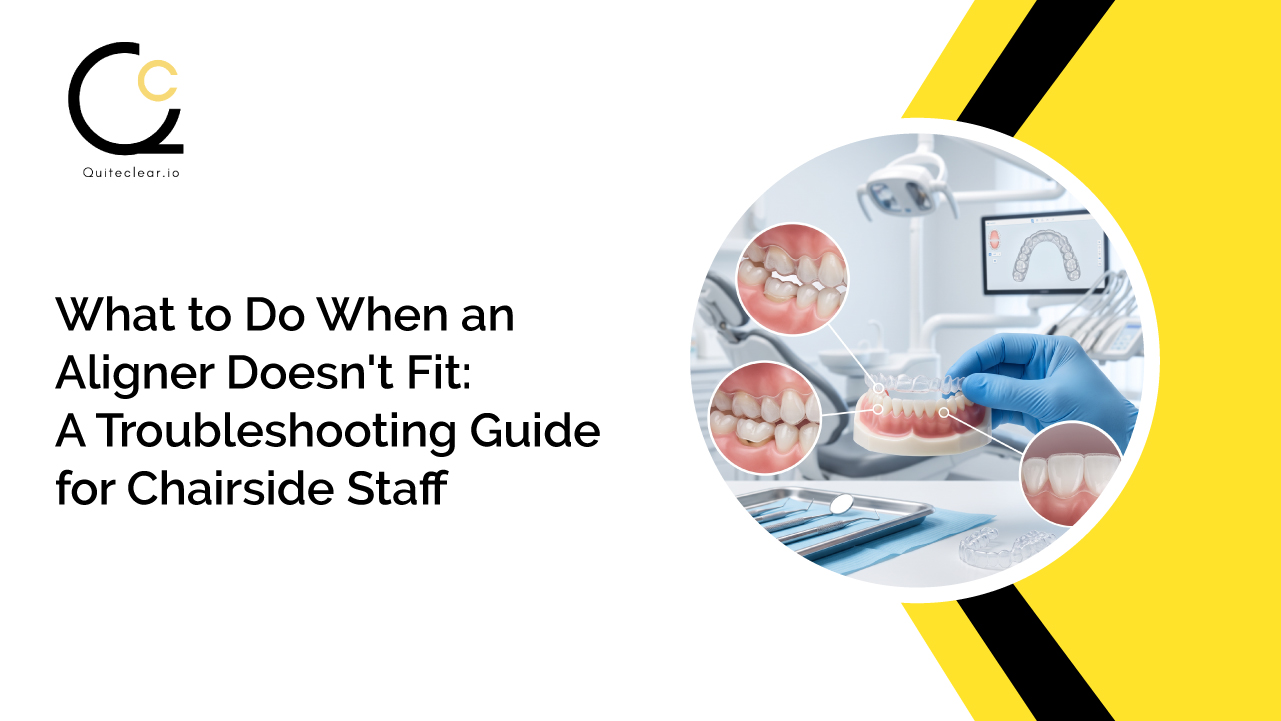
The aligner should fit. But it doesn’t. Now what?
A patient is in the chair, the next aligner is ready, and it simply won’t seat properly. Before assuming something has gone wrong, take a step back. An ill-fitting aligner can be caused by several factors—from tracking issues and missing attachments to inconsistent wear or a problem with the aligner itself.
The good news? A quick, systematic check can help you identify the issue and determine the right next step.
What Does “An Aligner Doesn’t Fit” Actually Mean?
“Doesn’t fit” can look different from one patient to another.
The aligner may refuse to seat completely, leave a visible gap around one or more teeth, feel unusually loose, or fit well in one area but not another. An attachment may also fail to engage properly with the corresponding space in the aligner.
The first step is to identify where and how the fit is off. A localized gap may point to a specific tracking or attachment issue, while a problem across several teeth may require a broader assessment.
First: Check the Aligner and the Patient
Before troubleshooting, start with the basics.
Check the aligner: Make sure the patient has the correct aligner for the correct:
- Arch
- Treatment stage
- Patient
Then inspect the aligner for visible cracks, distortion, rough edges, or other damage. Improper storage or exposure to excessive heat can affect its shape.
Check the patient’s teeth: Next, look at how the teeth are tracking against the planned movement. Check whether attachments are present and intact, and whether any recent dental procedures, restorations, or other changes could affect the fit.
This simple check can help determine whether you’re dealing with an aligner problem, a tooth-tracking problem, or both.
Common Reasons an Aligner May Not Fit
- The Teeth Aren’t Tracking as Expected: One of the most common reasons an aligner stops fitting properly is that the teeth have not moved as closely to the planned position as expected.
Tooth movement can vary from patient to patient. Inconsistent wear, insufficient seating, or individual biological differences can all contribute to tracking discrepancies. If the teeth are behind the planned movement, the next aligner may no longer fit as intended.
- An Attachment Is Missing or Damaged: Attachments provide additional contact points that help the aligner achieve specific tooth movements.
If an attachment has come off, fractured, or changed shape, the aligner may not engage correctly. In some cases, the attachment itself may prevent the aligner from seating properly. Check the attachment areas carefully and compare them with the treatment plan before deciding what to do next.
- The Patient Hasn’t Worn the Aligner as Recommended: Clear aligner treatment depends on consistent wear. If the aligner has not been worn for the prescribed amount of time, the teeth may not have progressed enough for the next stage.
Ask about the patient’s actual wear routine rather than assuming non-compliance. Simple questions about how often they remove the aligner, whether they use seating aids, and how consistently they wear it can provide useful context.
- The Aligner Has Been Damaged or Deformed: An aligner that has been exposed to excessive heat, stored incorrectly, or physically damaged may lose its intended shape.
Look for warping, cracks, unusual edges, or other visible changes. If the appliance itself appears compromised, it may not be appropriate to continue troubleshooting it as though the issue were purely related to tooth movement.
- The Patient Has Had Recent Dental Work: A new restoration, filling, crown, or other dental procedure can change the shape or surface of a tooth.
Even a relatively small change can affect how an aligner seats. Always ask whether the patient has had any dental work since the last appointment, especially if an aligner that previously fit suddenly becomes difficult to seat.
A Simple Chairside Troubleshooting Process
When an aligner doesn’t fit, avoid jumping straight to a solution. Work through the problem systematically.
Step 1: Verify the aligner. Confirm the patient, arch, and treatment stage.
Step 2: Inspect the aligner. Look for cracks, distortion, damage, or obvious manufacturing issues.
Step 3: Check tooth tracking. Look for gaps between the aligner and teeth and identify where the discrepancy occurs.
Step 4: Check attachments. Confirm that attachments are present, intact, and corresponding correctly with the aligner.
Step 5: Ask about wear. Confirm whether the patient has been following the prescribed wear schedule and seating instructions.
Step 6: Check for recent dental work. Find out whether any restorations or procedures could have changed tooth anatomy.
Step 7: Document the findings. Record what you observed and, where appropriate, capture photographs or scans according to the practice’s protocol.
Step 8: Escalate when necessary. If the problem cannot be resolved through routine chairside checks, have the treating dentist or orthodontist assess the case.
What Chairside Staff Should NOT Do
Troubleshooting doesn’t mean modifying the aligner or changing the treatment plan independently.
Avoid:
- Forcing an aligner into place
- Cutting or reshaping the aligner without clinical instruction
- Applying heat to change its shape
- Automatically moving the patient to the next stage
- Advising the patient to ignore significant pain or discomfort
- Assuming that every fit issue is caused by poor compliance
The role of chairside staff is to identify, assess, document, and communicate the issue. Decisions about treatment modifications should remain with the treating clinician.
When Should You Escalate the Case?
Some fit problems need closer clinical assessment. Escalate the issue when:
- The aligner cannot be seated properly
- There is a significant or persistent tracking discrepancy
- An attachment is missing or damaged
- The patient reports significant pain or unusual symptoms
- The aligner appears warped or defective
- Recent dental work has changed the tooth shape
- Several consecutive aligners are not fitting
- The current fit could affect the planned tooth movement
When in doubt, documenting the problem and getting the clinician’s assessment is safer than trying to force a solution chairside.
How to Document an Ill-Fitting Aligner
Good documentation makes follow-up much easier. Record the:
- Aligner number and arch
- Location and type of fit issue
- Condition of the aligner
- Attachment status
- Patient’s reported wear routine
- Recent dental procedures, if any
- Photos or scans, where required
- Steps taken chairside
- Clinician’s instructions or next steps
Clear documentation also helps the clinical team recognize whether the issue is isolated or part of a recurring tracking problem.
How to Prevent Aligner Fit Problems
Not every fit issue can be prevented, but consistent chairside checks can help catch problems early.
Reinforce proper wear and seating instructions with patients. Check attachments regularly and encourage patients to report lost attachments or damaged aligners promptly. Make sure aligners are stored appropriately and review fit before progressing through treatment stages.
Most importantly, don’t wait for a major fit problem to appear. Small tracking discrepancies are easier to address when they’re identified early.
Quick Chairside Checklist
Before moving forward, ask:
☐ Is this the correct aligner and treatment stage?
☐ Is the aligner undamaged and properly shaped?
☐ Are the teeth tracking as expected?
☐ Are all attachments present and intact?
☐ Has the patient followed the prescribed wear schedule?
☐ Has the patient had recent dental work?
☐ Does the aligner seat fully?
☐ Has the issue been documented?
☐ Does the treating clinician need to review it?
An aligner that doesn’t fit isn’t necessarily a sign that treatment has gone off track—but it is a reason to pause and investigate.
By checking the aligner, assessing tooth tracking, reviewing attachments and wear, and documenting what you find, chairside staff can help identify fit problems early and ensure the treating clinician has the information needed to decide the next step.
For practices and aligner professionals, the quality of the aligner itself also matters. Quiteclear focuses on clear aligner solutions designed to support predictable, patient-focused orthodontic treatment.
Looking for reliable clear aligner solutions for your practice? Connect with Quiteclear to learn more.